Programme Parameters
Advanced Postgrad
3 Days (4.5 Hrs)
Online (e-LMS)
• Prior working knowledge of the field and comfort with core tools and quantitative reasoning.
• A laptop or desktop with a stable internet connection.
• Willingness to complete assignments and the capstone project.
About This Course
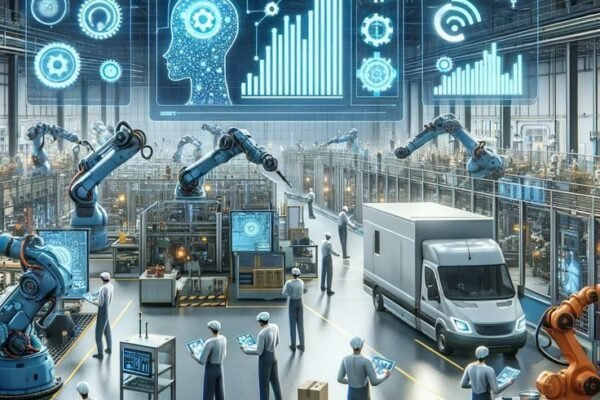
Industry 5.0: Hands-on AI in Manufacturing moves beyond the automation focus of Industry 4.0 to its human-centred successor. You learn what distinguishes Industry 5.0 — collaboration between people and intelligent systems, mass personalisation, and sustainability and resilience as first-class goals — and get hands-on with the AI that enables it: collaborative robots (cobots), adaptive quality and process control, and human-in-the-loop decision systems. The course connects technology to the values reshaping manufacturing. You finish able to apply AI within a human-centred, sustainable production vision. A verified e-Certificate of competency and e-Marksheet from the Deep Science & Technology Consortium.
🎯 Program Aim
This hands-on course covers Industry 5.0 and AI in manufacturing — human-AI collaboration, cobots, mass personalisation and sustainable, resilient production.
📋 Course Objectives
1. Explain how Industry 5.0 differs from Industry 4.0.
2. Design human-AI collaboration and cobot workflows.
3. Apply AI to adaptive quality and process control.
4. Support mass personalisation with data.
5. Build resilience and sustainability into production.
👥 Who Should Enroll?
• Manufacturing and automation engineers
• Industrial data scientists
• Operations and transformation leaders
• Students of advanced manufacturing
🚀 Key Learning Outcomes
• A hands-on grasp of Industry 5.0 AI.
• A human-centred manufacturing perspective.
• An applied production-AI project.
• A verified e-Certificate of competency and e-Marksheet from the Deep Science & Technology Consortium.
💎 What You'll Gain
Live & Recorded Sessions
Lifetime access to class recordingse-Certificate on Completion
Cryptographically verified credentialPost-Programme Support
Direct access to mentors & councilHands-On Experience
Notebooks, real-world code & datasetsCurriculum Outline
What Industry 5.0 Adds to 4.0
• Human-centricity, resilience and sustainability as the three stated pillars
• Automation that augments an operator rather than replacing them
• Where the label is genuinely new and where it is rebranding
Working Alongside Robots
• Cobot operating modes and the safety requirements of ISO/TS 15066
• Speed and separation monitoring, power and force limiting in practice
• Task allocation between human and machine on capability, not cost alone
AI on the Production Floor
• Vision-based quality inspection and the defect classes with too few examples
• Operator assistance: guidance, augmented reality and adaptive instructions
• Explainability, because an operator will not act on an unexplained alert
Mass Personalisation
• Batch-size-one production and the changeover cost it demands solving
• Reconfigurable lines, digital thread and traceability per unit
• Scheduling and planning under high product variety
Sustainable and Robust Operations
• Energy and material monitoring, and emissions accounting on the line
• Supply chain disruption, redundancy and the cost of resilience
• Workforce skills, acceptance and change management as the real constraint
Technical Specifications
| Parameter | Requirement |
|---|---|
| Covered Tool / Platform | Python |
| Covered Tool / Platform | TensorFlow |
| Covered Tool / Platform | PyTorch |
| Covered Tool / Platform | Keras |
| Covered Tool / Platform | Scikit-learn |
| Covered Tool / Platform | Jupyter Notebook |
| Covered Tool / Platform | Google Colab |
| Covered Tool / Platform | Hugging Face |
Frequently Asked Questions
Scholar Feedback & Reviews
Based on 0 scholar submissions
Rating Breakdown
No verified reviews published yet. Be the first to share your academic experience.
Leave Scholar Feedback
Your rating will help prospective scholars. Ratings below 3 stars are routed privately to the faculty mentor for immediate response.