Programme Parameters
Graduate / Intermediate
4 Days (6 Hrs)
Online (e-LMS)
• A basic understanding of the subject area and fundamental programming or scientific concepts.
• A laptop or desktop with a stable internet connection.
• Willingness to complete assignments and the capstone project.
About This Course
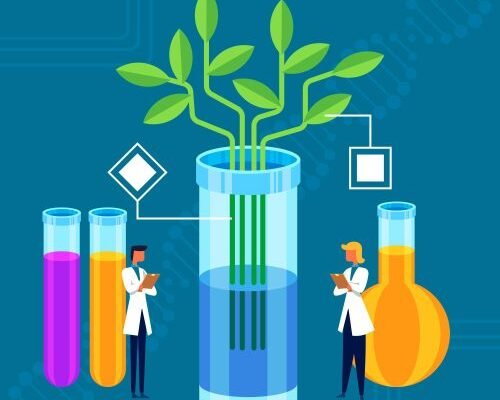
AI, Biopolymers, and Smart Sensors to Revolutionize Agriculture brings together three technologies transforming farming. You learn how biodegradable biopolymer-based sensors can monitor soil and crop conditions without leaving plastic behind, how smart sensor networks gather field data, and how AI turns that data into decisions on irrigation, nutrition and crop health. The course connects sustainable materials, sensing and machine learning into an integrated vision of precision agriculture that is both smarter and greener. You finish able to reason about an integrated AI-sensor-materials approach to a farming problem. A verified e-Certificate of competency and e-Marksheet from the Deep Science & Technology Consortium.
🎯 Program Aim
This course integrates AI, biopolymers and smart sensors for agriculture — biodegradable sensors, AI-driven monitoring and sustainable materials for precision farming.
📋 Course Objectives
1. Explain biopolymer-based biodegradable sensors.
2. Design smart sensor networks for field data.
3. Apply AI to crop, soil and irrigation decisions.
4. Integrate sustainable materials with sensing.
5. Connect the system to precision-agriculture goals.
👥 Who Should Enroll?
• Agri-tech and materials researchers
• Precision-agriculture professionals
• Sensor and data engineers in agriculture
• Students of sustainable agriculture
🚀 Key Learning Outcomes
• An integrated view of smart, sustainable agriculture.
• The ability to reason about AI-sensor-materials systems.
• A sustainability-focused agri-tech approach.
• A verified e-Certificate of competency and e-Marksheet from the Deep Science & Technology Consortium.
💎 What You'll Gain
Live & Recorded Sessions
Lifetime access to class recordingse-Certificate on Completion
Cryptographically verified credentialPost-Programme Support
Direct access to mentors & councilHands-On Experience
Notebooks, real-world code & datasetsCurriculum Outline
Biopolymers for Agricultural Use
• Biopolymer families used in coatings, mulches and controlled release
• Degradation behaviour in soil and the standards that define it
• Formulation constraints for field application and shelf stability
Smart Sensors in the Field
• Soil moisture, nutrient and plant-wearable sensing approaches
• Biodegradable and low-cost sensor substrates
• Calibration drift, fouling and the realities of leaving devices in a field
From Sensor Network to Usable Signal
• Low-power wireless networks and intermittent connectivity
• Data fusion across sensors, imagery and weather sources
• Handling sparse, noisy and partially missing agronomic data
Models for Agronomic Decisions
• Controlled-release scheduling informed by sensed soil state
• Stress and disease detection combining sensor and image signals
• Recommendation systems constrained by agronomic feasibility
Field Trials and Economics
• Trial design that produces evidence a farmer would act on
• Cost per hectare against realistic yield or input savings
• Regulatory and environmental considerations for novel materials
Technical Specifications
| Parameter | Requirement |
|---|---|
| Covered Tool / Platform | Python |
| Covered Tool / Platform | ArcGIS |
| Covered Tool / Platform | CropSyst |
| Covered Tool / Platform | DSSAT |
| Covered Tool / Platform | QGIS |
| Covered Tool / Platform | Drone Technology |
Frequently Asked Questions
Scholar Feedback & Reviews
Based on 0 scholar submissions
Rating Breakdown
No verified reviews published yet. Be the first to share your academic experience.
Leave Scholar Feedback
Your rating will help prospective scholars. Ratings below 3 stars are routed privately to the faculty mentor for immediate response.