Programme Parameters
Graduate / Intermediate
3 Days (4.5 Hrs)
Online (e-LMS)
• A basic understanding of the subject area and fundamental programming or scientific concepts.
• A laptop or desktop with a stable internet connection.
• Willingness to complete assignments and the capstone project.
About This Course
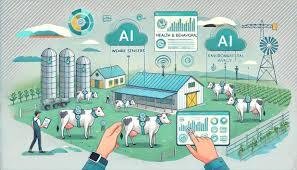
Precision Livestock Farming brings data and machine learning to animal agriculture. You work with the sensor and imaging data now common on modern farms — wearables, cameras and environmental monitors — and build models for the field’s priorities: early detection of illness and stress, optimising feed and nutrition, and supporting genetic selection for productivity and welfare. The course connects these models to real farm decisions and the growing emphasis on animal welfare and sustainability. You finish able to apply AI to a livestock-management problem. A verified e-Certificate of competency and e-Marksheet from the Deep Science & Technology Consortium.
🎯 Program Aim
This course applies AI to precision livestock farming — sensor-based health monitoring, nutrition optimisation and genetic selection for productive, welfare-focused animal agriculture.
📋 Course Objectives
1. Work with livestock sensor, wearable and imaging data.
2. Build models for early health and stress detection.
3. Optimise feed and nutrition with data.
4. Support genetic selection with analytics.
5. Connect models to welfare and farm decisions.
👥 Who Should Enroll?
• Animal scientists and veterinarians
• Agri-tech developers and data scientists
• Livestock and dairy professionals
• Students in animal and agricultural science
🚀 Key Learning Outcomes
• The ability to apply AI to livestock management.
• A precision-livestock analytics project.
• Welfare- and sustainability-aware modelling skills.
• A verified e-Certificate of competency and e-Marksheet from the Deep Science & Technology Consortium.
💎 What You'll Gain
Live & Recorded Sessions
Lifetime access to class recordingse-Certificate on Completion
Cryptographically verified credentialPost-Programme Support
Direct access to mentors & councilHands-On Experience
Notebooks, real-world code & datasetsCurriculum Outline
Sensing Animals at Scale
• Accelerometer, rumination and location sensing on individual animals
• Computer vision for body condition, lameness and behaviour
• Sensor attachment, welfare and data loss under farm conditions
Early Disease Detection
• Behavioural change as an early illness indicator, and its weak specificity
• Mastitis, lameness and respiratory disease detection models
• Alert thresholds set against the cost of a missed case and a false alarm
Feeding and Efficiency
• Individual intake measurement and feed conversion efficiency
• Ration formulation and precision supplementation
• Methane and nitrogen output as environmental performance measures
Genomic Selection
• Genomic estimated breeding values and reference population requirements
• Trait recording quality as the limit on genetic progress
• Balancing production traits against health, fertility and welfare
Welfare, Data and Adoption
• Animal welfare framing and avoiding pure productivity optimisation
• Farm data ownership, platform interoperability and lock-in
• Return on investment at herd scales typical in the region
Technical Specifications
| Parameter | Requirement |
|---|---|
| Covered Tool / Platform | Python |
| Covered Tool / Platform | TensorFlow |
| Covered Tool / Platform | PyTorch |
| Covered Tool / Platform | Keras |
| Covered Tool / Platform | Scikit-learn |
| Covered Tool / Platform | Jupyter Notebook |
| Covered Tool / Platform | Google Colab |
| Covered Tool / Platform | Hugging Face |
Frequently Asked Questions
Scholar Feedback & Reviews
Based on 0 scholar submissions
Rating Breakdown
No verified reviews published yet. Be the first to share your academic experience.
Leave Scholar Feedback
Your rating will help prospective scholars. Ratings below 3 stars are routed privately to the faculty mentor for immediate response.