Programme Parameters
Advanced Postgrad
3 Days (4.5 Hrs)
Online (e-LMS)
• Prior working knowledge of the field and comfort with core tools and quantitative reasoning.
• A laptop or desktop with a stable internet connection.
• Willingness to complete assignments and the capstone project.
About This Course
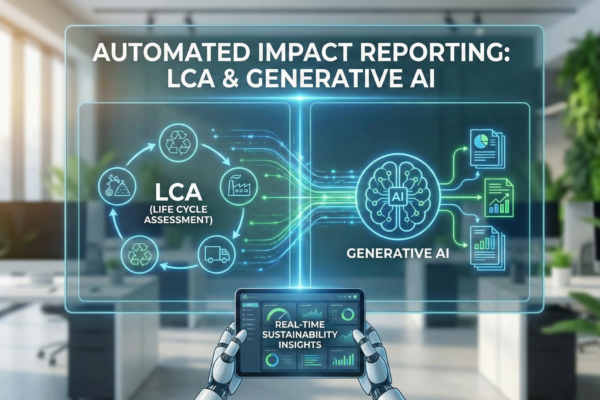
AI for LCA Automation: Real-Time Data, NLP & Predictive Impact Modeling tackles the biggest barrier to life-cycle assessment: it is slow and data-hungry. You learn how AI accelerates and scales LCA — pulling and structuring data with NLP, filling inventory gaps with predictive models, and integrating real-time and IoT data for dynamic footprints. The course connects automation to faster, more current environmental decisions while keeping ISO-grounded rigour. You finish able to reason about automating parts of an LCA workflow with AI. A verified e-Certificate of competency and e-Marksheet from the Deep Science & Technology Consortium.
🎯 Program Aim
This course covers AI for LCA automation — using real-time data, NLP and predictive modelling to speed and scale life-cycle assessment of products and processes.
📋 Course Objectives
1. Structure LCA data using NLP.
2. Fill inventory gaps with predictive models.
3. Integrate real-time and IoT data.
4. Automate impact modelling.
5. Preserve methodological rigour in automation.
👥 Who Should Enroll?
• Sustainability and LCA professionals
• Environmental data scientists
• Product and operations teams
• Students of industrial ecology
🚀 Key Learning Outcomes
• An understanding of AI-automated LCA.
• A faster life-cycle-assessment perspective.
• An environmental-analytics project.
• A verified e-Certificate of competency and e-Marksheet from the Deep Science & Technology Consortium.
💎 What You'll Gain
Live & Recorded Sessions
Lifetime access to class recordingse-Certificate on Completion
Cryptographically verified credentialPost-Programme Support
Direct access to mentors & councilHands-On Experience
Notebooks, real-world code & datasetsCurriculum Outline
Day 1 – Intelligent Data Ingestion & NLP for Inventory (LCI)
Automate extraction of material flows from unstructured technical texts using NLP. • Standardize units and nomenclature via Python logic. • Build scalable databases ready for LCA software integration. • Implement a hands‑on project – Automated Material Parser with spaCy.
Day 2 – Dynamic Monitoring & Real‑Time Impact Dashboards
Connect LCA models to live data feeds via open‑source APIs. • Create temporal impact assessments that reflect regional grid mixes. • Design interactive ESG dashboards with Plotly. • Hands‑on Project – Real‑Time Carbon Dashboard using Pandas & Plotly.
Day 3 – Predictive Analytics & AI‑Driven Design Optimization
Develop regression models to forecast GWP of new products. • Generate AI‑based material substitution recommendations. • Run sensitivity and risk analysis for future carbon‑tax scenarios. • Hands‑on Project – ‘What‑If’ Scenario Predictor with Scikit‑Learn.
Technical Specifications
| Parameter | Requirement |
|---|---|
| Covered Tool / Platform | Python |
| Covered Tool / Platform | spaCy |
| Covered Tool / Platform | Pandas |
| Covered Tool / Platform | Plotly |
| Covered Tool / Platform | Scikit-Learn |
| Covered Tool / Platform | Open-source APIs |
Frequently Asked Questions
Scholar Feedback & Reviews
Based on 0 scholar submissions
Rating Breakdown
No verified reviews published yet. Be the first to share your academic experience.
Leave Scholar Feedback
Your rating will help prospective scholars. Ratings below 3 stars are routed privately to the faculty mentor for immediate response.