Programme Parameters
Graduate / Intermediate
3 Days (4.5 Hrs)
Online (e-LMS)
• A basic understanding of the subject area and fundamental programming or scientific concepts.
• A laptop or desktop with a stable internet connection.
• Willingness to complete assignments and the capstone project.
About This Course
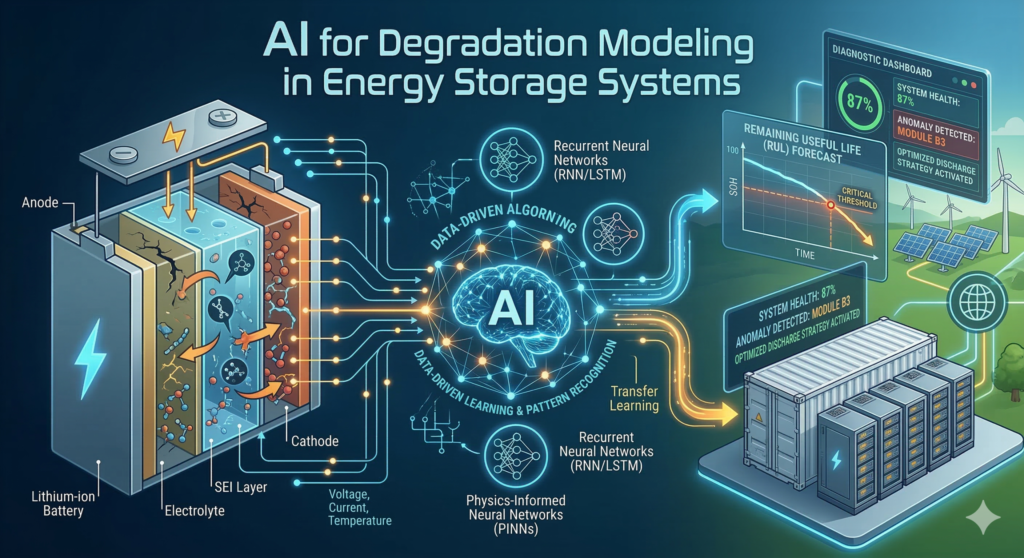
AI for Degradation Modeling in Energy Storage Systems focuses on a critical question for batteries and storage: how they age and how long they will last. You learn the mechanisms of battery degradation, then how machine learning predicts state of health and remaining useful life from cycling and operating data — often more effectively than physics-based models alone. The course connects these predictions to real decisions in battery management, warranty, second-life use and grid storage. You finish able to reason about an AI battery-degradation model. A verified e-Certificate of competency and e-Marksheet from the Deep Science & Technology Consortium.
🎯 Program Aim
This course applies AI to degradation modeling in energy storage — predicting battery ageing, state of health and remaining useful life from operating data.
📋 Course Objectives
1. Explain battery degradation mechanisms.
2. Predict state of health from operating data.
3. Estimate remaining useful life.
4. Combine data-driven and physics-based models.
5. Connect predictions to storage decisions.
👥 Who Should Enroll?
• Battery and energy-storage engineers
• Data scientists in energy and materials
• EV and grid-storage professionals
• Students of energy systems
🚀 Key Learning Outcomes
• An understanding of AI degradation modelling.
• A battery state-of-health perspective.
• A storage-management project.
• A verified e-Certificate of competency and e-Marksheet from the Deep Science & Technology Consortium.
💎 What You'll Gain
Live & Recorded Sessions
Lifetime access to class recordingse-Certificate on Completion
Cryptographically verified credentialPost-Programme Support
Direct access to mentors & councilHands-On Experience
Notebooks, real-world code & datasetsCurriculum Outline
Day 1 – Foundations of Energy Storage Degradation
Explore core energy‑storage technologies and degradation mechanisms • Identify key health indicators such as SOC, SOH, and RUL • Contrast data‑driven and physics‑based modeling approaches • Analyze real battery datasets in Google Colab
Day 2 – Machine Learning for Degradation Prediction
Extract informative features from voltage, current, temperature, and cycle data • Build regression and ensemble models (Linear Regression, Random Forest, SVM) • Validate models using MAE, RMSE and robust cross‑validation • Implement a full SOH prediction workflow with Scikit‑learn
Day 3 – Advanced AI for Prognostics & Smart Battery Systems
Design LSTM‑based time‑series models for RUL forecasting • Integrate physics‑informed AI for accurate health estimation • Explore AI‑enabled Battery Management Systems and predictive maintenance • Experiment with digital‑twin concepts for grid‑scale storage analytics
Technical Specifications
| Parameter | Requirement |
|---|---|
| Covered Tool / Platform | Python |
| Covered Tool / Platform | Google Colab |
| Covered Tool / Platform | Jupyter Notebook |
| Covered Tool / Platform | Scikit-learn |
| Covered Tool / Platform | TensorFlow |
| Covered Tool / Platform | Keras |
Frequently Asked Questions
Scholar Feedback & Reviews
Based on 0 scholar submissions
Rating Breakdown
No verified reviews published yet. Be the first to share your academic experience.
Leave Scholar Feedback
Your rating will help prospective scholars. Ratings below 3 stars are routed privately to the faculty mentor for immediate response.