Programme Parameters
Advanced Postgrad
3 Days (4.5 Hrs)
Online (e-LMS)
• Prior working knowledge of the field and comfort with core tools and quantitative reasoning.
• A laptop or desktop with a stable internet connection.
• Willingness to complete assignments and the capstone project.
About This Course
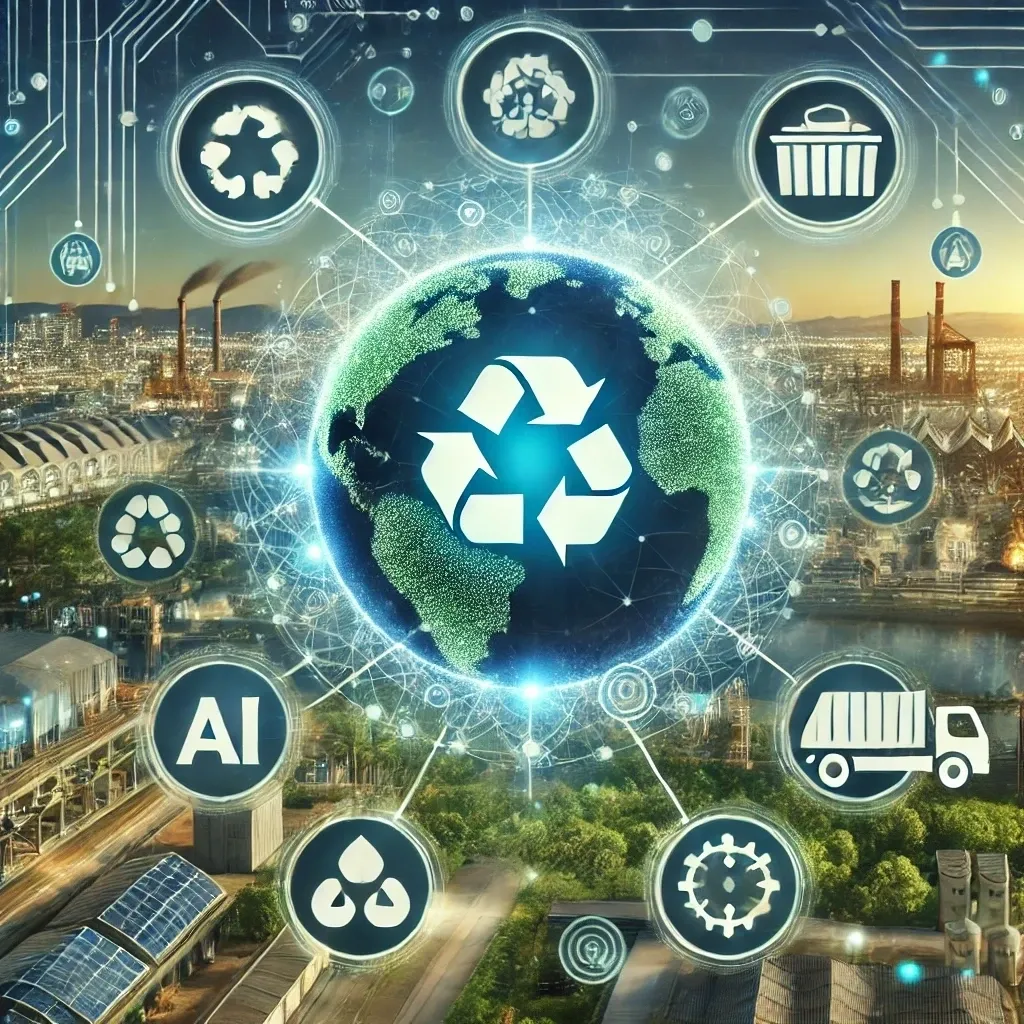
AI for Circular Manufacturing applies machine learning to closing the loop in industry: keeping materials in use rather than discarding them. You learn to apply AI across circular strategies — reducing waste and scrap in production, sorting and recovering materials for recycling, and enabling remanufacturing and predictive material reuse. The course connects these to the wider goals of a circular economy and the operational data that makes them tractable. Grounded in real manufacturing, it shows AI turning waste into value. You finish able to reason about an AI-driven circular-manufacturing solution. A verified e-Certificate of competency and e-Marksheet from the Deep Science & Technology Consortium.
🎯 Program Aim
This course applies AI to circular manufacturing — waste reduction, recycling, remanufacturing and material recovery for a closed-loop industrial system.
📋 Course Objectives
1. Identify circular strategies in manufacturing.
2. Apply AI to reduce production waste and scrap.
3. Use computer vision for material sorting and recovery.
4. Support remanufacturing and material reuse.
5. Connect operations to circular-economy goals.
👥 Who Should Enroll?
• Manufacturing and sustainability engineers
• Operations and process professionals
• Data scientists in industry
• Students of sustainable manufacturing
🚀 Key Learning Outcomes
• An understanding of AI in circular manufacturing.
• A waste-reduction or recovery project.
• A circular-economy operations mindset.
• A verified e-Certificate of competency and e-Marksheet from the Deep Science & Technology Consortium.
💎 What You'll Gain
Live & Recorded Sessions
Lifetime access to class recordingse-Certificate on Completion
Cryptographically verified credentialPost-Programme Support
Direct access to mentors & councilHands-On Experience
Notebooks, real-world code & datasetsCurriculum Outline
Foundations of Circular Manufacturing
Define circular manufacturing principles and waste hierarchies • Analyse material flow using AI‑based tracking • Identify key performance indicators for waste reduction
Data Acquisition & Pre‑processing
Collect sensor and ERP data from production lines • Clean and normalise heterogeneous waste datasets • Engineer features for recycling and energy‑recovery models
Predictive Analytics for Waste Generation
Build regression models to forecast waste streams • Validate models with cross‑validation on industrial data • Deploy models for real‑time monitoring
AI‑Optimised Recycling Strategies
Apply clustering to segment recyclable materials • Design decision‑support systems for route optimisation • Integrate reinforcement learning for adaptive sorting
Waste‑to‑Energy Conversion Modelling
Model calorific value using AI‑driven thermodynamic equations • Optimise feedstock mix for maximum energy yield • Simulate plant performance under varying load conditions
Deployment & Continuous Improvement
Containerise models with Docker for scalable rollout • Set up monitoring dashboards and alerting • Implement feedback loops for model retraining
Technical Specifications
| Parameter | Requirement |
|---|---|
| Covered Tool / Platform | Python |
| Covered Tool / Platform | Pandas |
| Covered Tool / Platform | Scikit-learn |
| Covered Tool / Platform | TensorFlow |
| Covered Tool / Platform | PyTorch |
| Covered Tool / Platform | Docker |
| Covered Tool / Platform | PowerBI |
| Covered Tool / Platform | Tableau |
| Covered Tool / Platform | AWS SageMaker |
| Covered Tool / Platform | Azure ML |
Frequently Asked Questions
Scholar Feedback & Reviews
Based on 0 scholar submissions
Rating Breakdown
No verified reviews published yet. Be the first to share your academic experience.
Leave Scholar Feedback
Your rating will help prospective scholars. Ratings below 3 stars are routed privately to the faculty mentor for immediate response.