Programme Parameters
Graduate / Intermediate
4 Weeks (40 Hrs)
Online (e-LMS)
• A basic understanding of the subject area and fundamental programming or scientific concepts.
• A laptop or desktop with a stable internet connection.
• Willingness to complete assignments and the capstone project.
About This Course
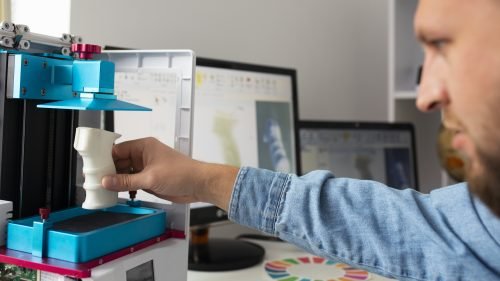
4D Printing for Sustainable Materials explores the frontier where additive manufacturing meets smart materials: objects that are 3D-printed and then transform — folding, expanding or changing properties — in response to heat, moisture, light or other stimuli. You study the stimuli-responsive materials that make this possible, the printing approaches and design principles behind programmable transformation, and the emerging applications in soft robotics, biomedical devices and adaptive structures. A sustainability lens runs throughout, from material choices to reduced waste. You finish able to reason about 4D-printing materials and design. A verified e-Certificate of competency and e-Marksheet from the Deep Science & Technology Consortium.
🎯 Program Aim
This course covers 4D printing — 3D-printed structures that change shape or function over time in response to stimuli — with a focus on smart, sustainable materials.
📋 Course Objectives
1. Explain 4D printing and stimuli-responsive transformation.
2. Compare shape-memory and responsive materials.
3. Understand printing approaches for programmable structures.
4. Design for shape or property change over time.
5. Assess applications and sustainability trade-offs.
👥 Who Should Enroll?
• Materials scientists and engineers
• Additive-manufacturing professionals
• Researchers in smart and soft materials
• Students specialising in advanced materials
🚀 Key Learning Outcomes
• An understanding of 4D printing and smart materials.
• The ability to reason about responsive-material design.
• A foundation in advanced additive manufacturing.
• A verified e-Certificate of competency and e-Marksheet from the Deep Science & Technology Consortium.
💎 What You'll Gain
Live & Recorded Sessions
Lifetime access to class recordingse-Certificate on Completion
Cryptographically verified credentialPost-Programme Support
Direct access to mentors & councilHands-On Experience
Notebooks, real-world code & datasetsCurriculum Outline
AI Fundamentals, Mathematics, and 4D Printing Foundations
Derive gradient descent formulations and backpropagation equations for training neural networks applied to stimulus-responsive material behavior prediction • Construct mathematical models of shape-memory polymers and self-healing materials using tensor calculus and continuum mechanics principles • Implement finite element analysis simulations in FEniCS or Abaqus to predict thermomechanical responses of 4D-printed sustainable composites
Data Engineering, Preprocessing, and Feature Pipelines
Architect ETL pipelines using Apache Airflow to ingest multi-modal sensor data from 4D printing processes including thermal imaging, rheometry, and in-situ X-ray tomography • Engineer physics-informed features from raw material characterization datasets using domain knowledge of glass transition temperatures, crystallization kinetics, and viscoelastic properties • Validate data quality and implement anomaly detection algorithms to identify outlier batches in time-series manufacturing data from smart material fabrication workflows
Model Architecture, Algorithm Design, and 4D Printing Methods
Design graph neural network architectures to represent molecular structures of bio-based polymers and predict their programmable shape-changing behaviors • Develop physics-informed neural networks (PINNs) that incorporate constitutive equations for hygroscopic expansion and thermal contraction into deep learning training objectives • Configure generative adversarial networks or variational autoencoders to optimize lattice structures and topologies for minimum material usage in biodegradable 4D-printed scaffolds
Training, Hyperparameter Optimization, and Evaluation
Execute distributed training strategies using Horovod or PyTorch DistributedDataParallel across GPU clusters for large-scale molecular dynamics simulation datasets • Apply Bayesian optimization with Optuna or Ray Tune to search hyperparameter spaces for models predicting degradation rates of cellulose-derived smart materials • Evaluate model generalization using cross-validation schemes tailored to temporal and spatial dependencies in additive manufacturing process data
Deployment, MLOps, and Production Workflows
Containerize trained models using Docker and orchestrate inference pipelines with Kubernetes for real-time quality control in 4D printing production environments • Implement MLflow or Kubeflow tracking systems to version datasets, model artifacts, and experimental configurations across sustainable material development cycles • Design edge deployment architectures for embedded systems controlling environmental actuation triggers in deployed 4D-printed sustainable infrastructure
Ethics, Bias Mitigation, and Responsible AI Practices
Audit training datasets and model outputs for geographic and demographic biases in sustainable material accessibility and environmental impact predictions • Establish governance frameworks ensuring compliance with EU Green Deal regulations, REACH chemical safety standards, and emerging AI accountability legislation • Implement explainability techniques including SHAP and LIME to interpret black-box predictions for stakeholders in regulatory and public health contexts
Industry Integration, Business Applications, and Case Studies
Analyze total cost of ownership and lifecycle assessment metrics for transitioning conventional manufacturing to AI-optimized 4D printing with sustainable feedstocks • Develop business models and value chain analyses for circular economy applications including self-disassembling electronics and adaptive architectural components • Synthesize lessons from deployed case studies in aerospace morphing structures, biomedical drug delivery systems, and responsive textile manufacturing
Technical Specifications
| Parameter | Requirement |
|---|---|
| Covered Tool / Platform | Python |
| Covered Tool / Platform | TensorFlow |
| Covered Tool / Platform | PyTorch |
| Covered Tool / Platform | FEniCS |
| Covered Tool / Platform | Abaqus |
| Covered Tool / Platform | Apache Airflow |
| Covered Tool / Platform | MLflow |
| Covered Tool / Platform | Kubernetes |
| Covered Tool / Platform | Docker |
| Covered Tool / Platform | Optuna |
Frequently Asked Questions
Scholar Feedback & Reviews
Based on 0 scholar submissions
Rating Breakdown
No verified reviews published yet. Be the first to share your academic experience.
Leave Scholar Feedback
Your rating will help prospective scholars. Ratings below 3 stars are routed privately to the faculty mentor for immediate response.