Programme Parameters
Graduate / Intermediate
3 Days (4.5 Hrs)
Online (e-LMS)
• A basic understanding of the subject area and fundamental programming or scientific concepts.
• A laptop or desktop with a stable internet connection.
• Willingness to complete assignments and the capstone project.
About This Course
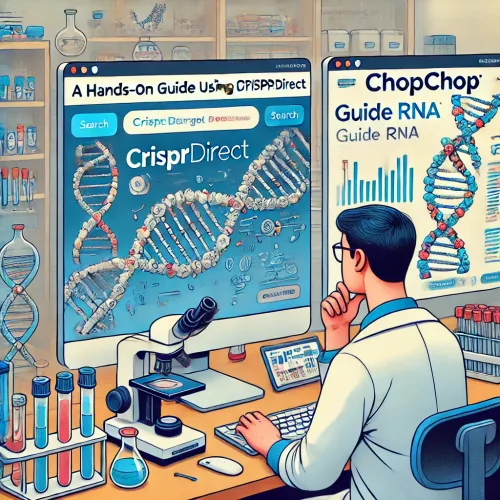
CRISPR technology has revolutionized the field of genetic research, making genome editing more accessible and precise. This 3-day course is designed to offer an in-depth, hands-on guide to using CRISPRdirect and CHOPCHOP, two powerful tools for designing CRISPR experiments. Every participant receives a verified e-Certificate and e-Marksheet from the Deep Science & Technology Consortium.
🎯 Program Aim
CRISPR technology has revolutionized the field of genetic research, making genome editing more accessible and precise. This 3-day course is designed to offer an in-depth, hands-on guide to using CRISPRdirect and CHOPCHOP, two powerful tools for designing CRISPR experiments.
📋 Course Objectives
1. Put biotechnology techniques to work on real datasets and case studies.
2. Produce a reproducible, portfolio-ready project you can cite in a thesis, paper, or job application.
👥 Who Should Enroll?
• Master's and senior undergraduate students specializing in biotechnology
• R&D engineers and working professionals applying biotechnology in industry
• Academics and educators building research or teaching capacity in biotechnology
🚀 Key Learning Outcomes
• A demonstrable biotechnology project for your research or industry portfolio.
• A verified e-Certificate of competency and e-Marksheet from the Deep Science & Technology Consortium.
💎 What You'll Gain
Live & Recorded Sessions
Lifetime access to class recordingse-Certificate on Completion
Cryptographically verified credentialPost-Programme Support
Direct access to mentors & councilHands-On Experience
Notebooks, real-world code & datasetsCurriculum Outline
Defining the Edit Before Designing Anything
• Knockout, knock-in and tagging goals dictate entirely different guide placement
• Retrieving the correct transcript and genome build — a mismatch invalidates the design
• Exon choice for a true null: early constitutive exons, avoiding alternative starts
Specificity-First Design
• Running a target sequence and reading the returned candidate list
• Interpreting the 20mer, 12mer and 8mer uniqueness columns
• Species and genome selection as the most common source of a wrong answer
Scoring and Ranking Guides
• On-target efficiency scoring and the models behind the numbers
• Off-target counts by mismatch number and the weighting between them
• Nuclease choice, PAM options and restriction-site output for screening
Choosing Between Candidate Guides
• Trading predicted efficiency against off-target risk for your application
• GC content, poly-T terminators and secondary structure in the sgRNA
• Why two or three independent guides should always be tested, not one
Confirming the Edit
• Primer design for the amplicon and its distance from the cut site
• T7E1 and TIDE or ICE for editing efficiency estimation
• Sanger and amplicon sequencing to characterise the actual allele obtained
Technical Specifications
| Parameter | Requirement |
|---|---|
| Covered Tool / Platform | Benchling |
| Covered Tool / Platform | CRISPOR |
| Covered Tool / Platform | Cas-OFFinder |
| Covered Tool / Platform | SnapGene |
| Covered Tool / Platform | Addgene |
| Covered Tool / Platform | NCBI Primer-BLAST |
Frequently Asked Questions
Scholar Feedback & Reviews
Based on 0 scholar submissions
Rating Breakdown
No verified reviews published yet. Be the first to share your academic experience.
Leave Scholar Feedback
Your rating will help prospective scholars. Ratings below 3 stars are routed privately to the faculty mentor for immediate response.