Programme Parameters
Advanced Postgrad
3 Days (4.5 Hrs)
Online (e-LMS)
• Prior working knowledge of the field and comfort with core tools and quantitative reasoning.
• A laptop or desktop with a stable internet connection.
• Willingness to complete assignments and the capstone project.
About This Course
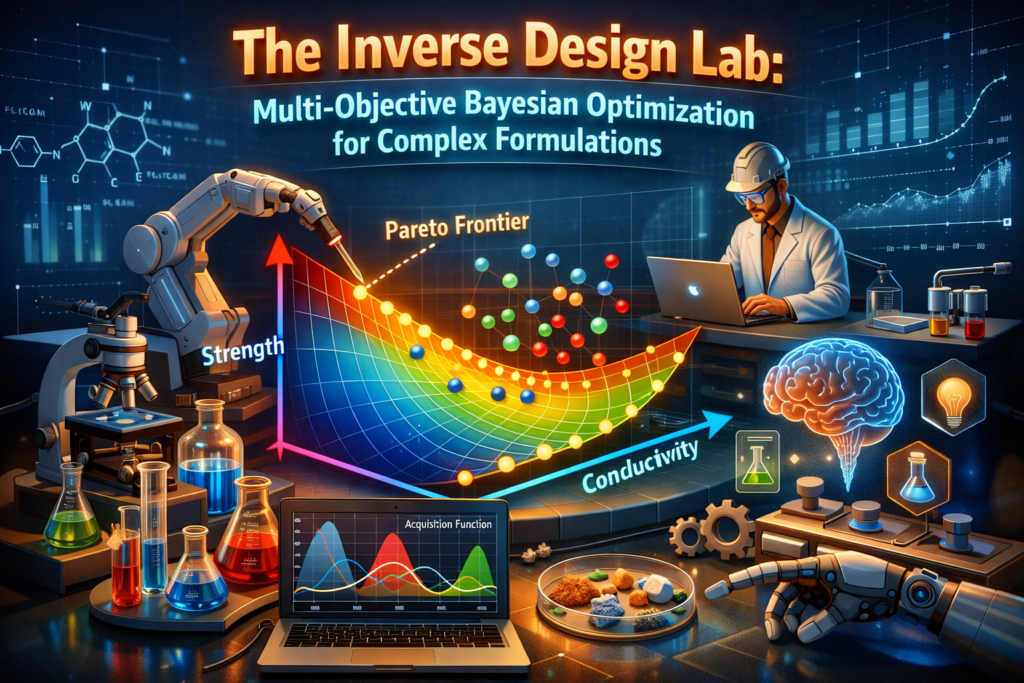
Bayesian Experimental Design is a 3-day intensive program by The Inverse Design Lab that empowers researchers to revolutionize their experimental workflows through the power of Bayesian Optimization and Gaussian Processes. This course bridges the gap between human scientific intuition and machine intelligence, enabling participants to optimize complex formulations with unprecedented efficiency. Across 4 Weeks, you will build practical fluency in power of Bayesian Optimization and Gaussian Processes, then consolidate everything in a capstone project. Every participant receives a verified e-Certificate and e-Marksheet from the Deep Science & Technology Consortium.
🎯 Program Aim
Bayesian Experimental Design is a 3-day intensive program by The Inverse Design Lab that empowers researchers to revolutionize their experimental workflows through the power of Bayesian Optimization and Gaussian Processes. This course bridges the gap between human scientific intuition and machine intelligence, enabling participants to optimize complex formulations with unprecedented efficiency.
📋 Course Objectives
1. Master the fundamentals of power of Bayesian Optimization.
2. Get comfortable working with Gaussian Processes.
3. Put AI Enablement techniques to work on real datasets and case studies.
4. Assemble a documented case study that evidences your applied capability.
👥 Who Should Enroll?
• Master's and senior undergraduate students specializing in AI Enablement
• R&D engineers and working professionals applying AI Enablement in industry
• Academics and educators building research or teaching capacity in AI Enablement
• Data and computational scientists moving into power of Bayesian Optimization
🚀 Key Learning Outcomes
• Confidence to implement power of Bayesian Optimization in real projects.
• Confidence to reason about Gaussian Processes in real projects.
• A demonstrable AI Enablement project for your research or industry portfolio.
• A verified e-Certificate of competency and e-Marksheet from the Deep Science & Technology Consortium.
💎 What You'll Gain
Live & Recorded Sessions
Lifetime access to class recordingse-Certificate on Completion
Cryptographically verified credentialPost-Programme Support
Direct access to mentors & councilHands-On Experience
Notebooks, real-world code & datasetsCurriculum Outline
Foundations of Gaussian Processes
Build Gaussian Process models to quantify uncertainty in experimental measurements • Configure GP regression using Python frameworks with real spreadsheet datasets • Visualize prediction intervals and confidence bounds for material property forecasting
Bayesian Optimization Fundamentals
Apply acquisition functions to strategically balance exploration against exploitation • Implement sequential experimental design to minimize costly laboratory iterations • Optimize single-objective problems using surrogate model-based search strategies
Multi-Objective Optimization & Pareto Frontier
Define competing objectives such as mechanical strength versus sorption capacity • Compute and visualize Pareto-optimal solutions for trade-off analysis • Execute closed-loop simulations where AI recommends next experimental conditions
Active Learning for Experimental Design
Design intelligent sampling strategies to maximize information gain per experiment • Integrate prior domain unscertainty into adaptive experimental planning workflows • Deploy active learning loops that refine models with minimal data requirements
Human-in-the-Loop AI Systems
Combine domain expertise with algorithmic recommendations for hybrid decision-making • Build recommender systems that generate optimal synthesis recipes from historical data • Validate AI-suggested experiments against physical constraints and safety boundaries
Real-World Applications in Materials & Chemistry
Optimize formulation parameters for advanced materials development pipelines • Apply Bayesian methods to catalysis, polymer design, and nanomaterial synthesis • Translate course projects into publishable research and industrial R&D workflows
Uncertainty Quantification & Model Validation
Assess model reliability through cross-validation and predictive diagnostics • Calibrate confidence estimates to prevent overconfident predictions • Implement robustness checks for safety-critical experimental applications
Technical Specifications
| Parameter | Requirement |
|---|---|
| Covered Tool / Platform | Python |
| Covered Tool / Platform | BoTorch |
| Covered Tool / Platform | GPyTorch |
| Covered Tool / Platform | NumPy |
| Covered Tool / Platform | SciPy |
| Covered Tool / Platform | Matplotlib |
Frequently Asked Questions
Scholar Feedback & Reviews
Based on 0 scholar submissions
Rating Breakdown
No verified reviews published yet. Be the first to share your academic experience.
Leave Scholar Feedback
Your rating will help prospective scholars. Ratings below 3 stars are routed privately to the faculty mentor for immediate response.