Programme Parameters
Advanced Postgrad
3 Days (4.5 Hrs)
Online (e-LMS)
• Prior working knowledge of the field and comfort with core tools and quantitative reasoning.
• A laptop or desktop with a stable internet connection.
• Willingness to complete assignments and the capstone project.
About This Course
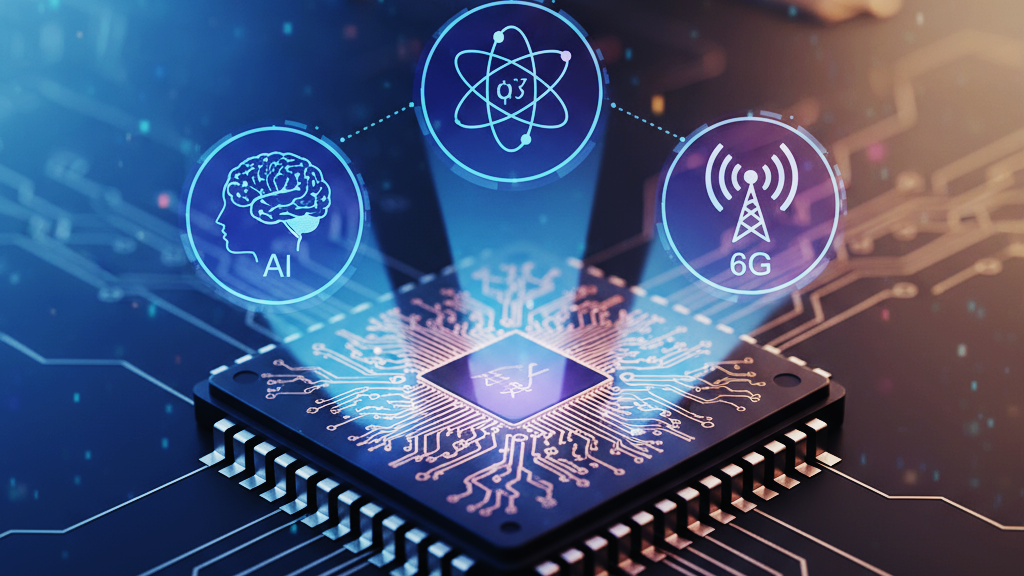
Quantum-Enhanced AI for Next-Gen Semiconductor Process Control sits at the intersection of three advanced fields. You learn the extraordinary complexity of modern chip fabrication and why its process control is such a demanding optimisation and monitoring problem. The course covers how machine learning already improves yield, defect detection and process tuning, and how quantum and quantum-inspired methods are being explored to push optimisation further. Balancing genuine promise against present reality, it connects semiconductor engineering to advanced computation. You finish able to reason about applying quantum-enhanced AI to a manufacturing-control problem. A verified e-Certificate of competency and e-Marksheet from the Deep Science & Technology Consortium.
🎯 Program Aim
This advanced course explores quantum-enhanced AI for semiconductor process control — applying quantum and machine-learning methods to optimise and control chip fabrication.
📋 Course Objectives
1. Explain semiconductor fabrication and process-control challenges.
2. Apply machine learning to yield, defect detection and tuning.
3. Understand quantum and quantum-inspired optimisation.
4. Assess where quantum enhancement is realistic.
5. Connect advanced computation to manufacturing control.
👥 Who Should Enroll?
• Semiconductor and process engineers
• Data scientists in manufacturing
• Quantum-computing and optimisation researchers
• Students of advanced manufacturing
🚀 Key Learning Outcomes
• An understanding of AI in semiconductor process control.
• A view of where quantum methods may help.
• A foundation in advanced manufacturing analytics.
• A verified e-Certificate of competency and e-Marksheet from the Deep Science & Technology Consortium.
💎 What You'll Gain
Live & Recorded Sessions
Lifetime access to class recordingse-Certificate on Completion
Cryptographically verified credentialPost-Programme Support
Direct access to mentors & councilHands-On Experience
Notebooks, real-world code & datasetsCurriculum Outline
Module 1 – Diffusion Models for Wafer Defect Synthesis & Zero‑Shot Classification
Implement Denoising U‑Net + DDPM architecture • Generate synthetic wafer maps using WM‑811K dataset • Apply CLIP‑based zero‑shot classification on wafer embeddings • Quantify prediction uncertainty with Monte‑Carlo Dropout
Module 2 – Physics‑Informed Neural Operators for Multi‑Scale Process Modeling
Code Fourier Neural Operators (FNO) from theory to practice • Embed Navier‑Stokes and lithography PDE constraints via PINN loss • Predict critical dimension (CD) across 1 nm‑100 µm resolution • Learn operator‑based etching‑rate field estimation
Module 3 – Causal Discovery & Multi‑Agent RL for Adaptive Fab Control
Discover causal graphs using PC algorithm and NOTEARS • Build distributed process controllers with Multi‑Agent PPO • Perform counterfactual ‘what‑if’ scenario analysis • Enforce safety via Lagrangian‑constrained RL (≤2 nm tolerance)
Technical Specifications
| Parameter | Requirement |
|---|---|
| Covered Tool / Platform | Google Colab |
| Covered Tool / Platform | Python |
| Covered Tool / Platform | TensorFlow |
| Covered Tool / Platform | PyTorch |
| Covered Tool / Platform | CUDA |
| Covered Tool / Platform | NumPy |
| Covered Tool / Platform | pandas |
| Covered Tool / Platform | scikit-learn |
| Covered Tool / Platform | OpenAI CLIP |
| Covered Tool / Platform | Fourier Neural Operator libraries |
Frequently Asked Questions
Scholar Feedback & Reviews
Based on 0 scholar submissions
Rating Breakdown
No verified reviews published yet. Be the first to share your academic experience.
Leave Scholar Feedback
Your rating will help prospective scholars. Ratings below 3 stars are routed privately to the faculty mentor for immediate response.