Programme Parameters
Advanced Postgrad
3 Days (4.5 Hrs)
Online (e-LMS)
• Prior working knowledge of the field and comfort with core tools and quantitative reasoning.
• A laptop or desktop with a stable internet connection.
• Willingness to complete assignments and the capstone project.
About This Course
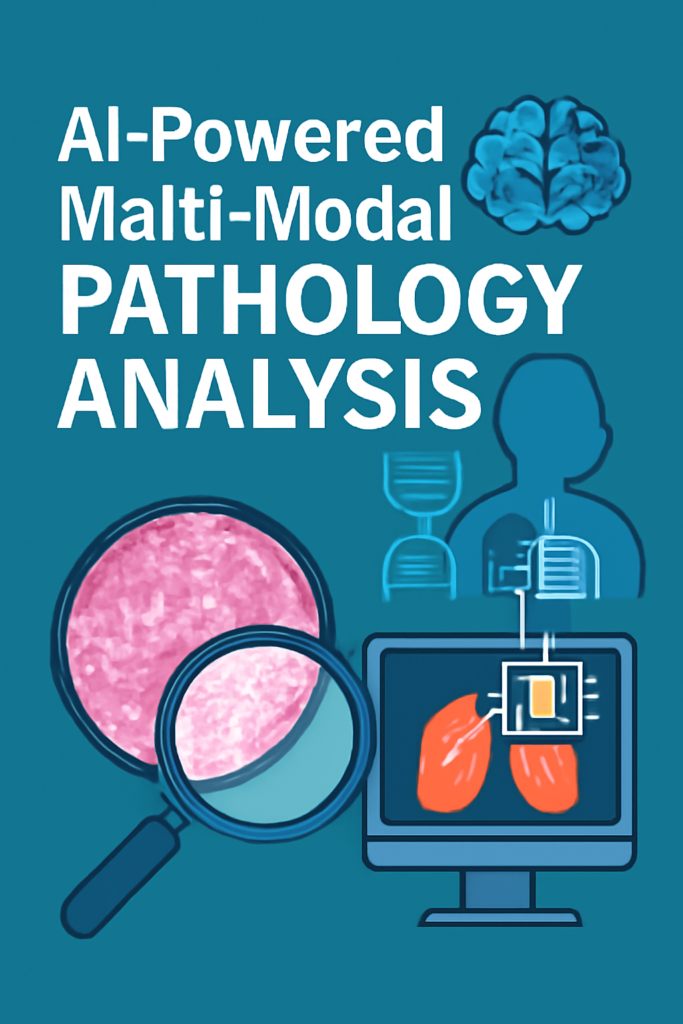
Pathology is crucial for diagnosing diseases like cancer, cardiovascular, and neurodegenerative disorders. While traditional pathology relies on visual examination, the rise of multi-modal data (imaging, genomics, clinical records) enables advanced, AI-driven analysis. Every participant receives a verified e-Certificate and e-Marksheet from the Deep Science & Technology Consortium.
🎯 Program Aim
Pathology is crucial for diagnosing diseases like cancer, cardiovascular, and neurodegenerative disorders. While traditional pathology relies on visual examination, the rise of multi-modal data (imaging, genomics, clinical records) enables advanced, AI-driven analysis.
📋 Course Objectives
1. Put biotechnology techniques to work on real datasets and case studies.
2. Build a defensible project you can showcase to supervisors, reviewers, or employers.
👥 Who Should Enroll?
• Master's and senior undergraduate students specializing in biotechnology
• R&D engineers and working professionals applying biotechnology in industry
• Academics and educators building research or teaching capacity in biotechnology
🚀 Key Learning Outcomes
• Tangible, reproducible biotechnology work to show supervisors or employers.
• A verified e-Certificate of competency and e-Marksheet from the Deep Science & Technology Consortium.
💎 What You'll Gain
Live & Recorded Sessions
Lifetime access to class recordingse-Certificate on Completion
Cryptographically verified credentialPost-Programme Support
Direct access to mentors & councilHands-On Experience
Notebooks, real-world code & datasetsCurriculum Outline
Foundations of Multi-Modal Pathology & AI
Understand the pivotal role of pathology in disease diagnosis. • Explore multi-modal data types: histopathology images, genomics, and clinical records. • Examine the fundamentals of AI, machine learning, and deep learning in healthcare.
AI in Single-Modality Pathology & Data Visualization
Analyze case studies demonstrating AI applications in single-modality pathology. • Practice loading and visualizing diverse pathology datasets. • Interpret initial findings from raw pathology data.
Multi-Modal Data Preprocessing & Feature Engineering
Apply techniques for data preprocessing and normalization across different modalities. • Extract relevant features from imaging, molecular, and clinical datasets. • Prepare data for advanced AI model training.
Deep Learning for Multi-Modal Data Integration
Utilize deep learning models (CNNs, autoencoders, multimodal fusion) for comprehensive analysis. • Integrate genomic, imaging, and clinical data using AI pipelines. • Discuss challenges and practical solutions in multi-modal data integration.
Hands-on AI Model Training & Application
Train a multi-modal AI model for tissue classification or disease prediction. • Develop predictive models for disease prognosis using integrated data. • Implement AI-assisted cancer detection and biomarker identification.
Clinical Translation & Future Directions in AI Pathology
Evaluate models using appropriate metrics and ensure interpretability for multi-modal AI. • Translate AI models into practical pathology workflows and clinical relevance. • Complete an end-to-end multi-modal pathology analysis workflow as a capstone exercise.
Technical Specifications
| Parameter | Requirement |
|---|---|
| Covered Tool / Platform | Python |
| Covered Tool / Platform | TensorFlow |
| Covered Tool / Platform | PyTorch |
| Covered Tool / Platform | Data Visualization Libraries |
Frequently Asked Questions
Scholar Feedback & Reviews
Based on 0 scholar submissions
Rating Breakdown
No verified reviews published yet. Be the first to share your academic experience.
Leave Scholar Feedback
Your rating will help prospective scholars. Ratings below 3 stars are routed privately to the faculty mentor for immediate response.