Programme Parameters
Graduate / Intermediate
4 Weeks (40 Hrs)
Online (e-LMS)
• A basic understanding of the subject area and fundamental programming or scientific concepts.
• A laptop or desktop with a stable internet connection.
• Willingness to complete assignments and the capstone project.
About This Course
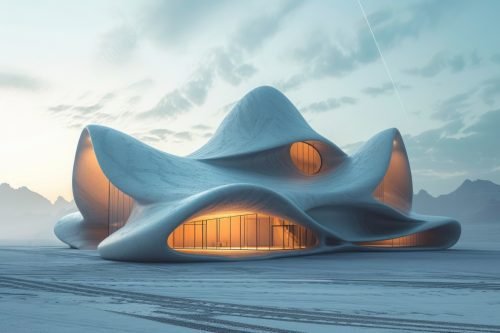
Mentor Based AI-Driven Arctic Architecture: Designing Climate-Resilient buildings tackles design at the planet’s harshest edge. You learn the distinctive constraints of Arctic and cold-climate building — extreme cold, permafrost, snow and a changing climate — and how AI supports performance-based design for warmth, efficiency and resilience in these conditions. With mentor guidance, the course connects cold-climate engineering to data-driven design. You finish able to reason about resilient architecture for Arctic and extreme-cold environments. A verified e-Certificate of competency and e-Marksheet from the Deep Science & Technology Consortium.
🎯 Program Aim
This mentor-based course covers AI-driven Arctic architecture — designing buildings for extreme cold, permafrost and climate change in polar and cold-climate regions.
📋 Course Objectives
1. Explain Arctic and cold-climate design constraints.
2. Design for permafrost, cold and snow.
3. Apply AI to performance-based cold-climate design.
4. Optimise for warmth, efficiency and resilience.
5. Adapt designs to a changing polar climate.
👥 Who Should Enroll?
• Architects and cold-climate engineers
• Sustainability and resilience professionals
• Polar and remote-region planners
• Students of resilient architecture
🚀 Key Learning Outcomes
• An understanding of Arctic architecture.
• A cold-climate resilience perspective.
• A climate-adaptive design foundation.
• A verified e-Certificate of competency and e-Marksheet from the Deep Science & Technology Consortium.
💎 What You'll Gain
Live & Recorded Sessions
Lifetime access to class recordingse-Certificate on Completion
Cryptographically verified credentialPost-Programme Support
Direct access to mentors & councilHands-On Experience
Notebooks, real-world code & datasetsCurriculum Outline
AI Fundamentals, Mathematics, and Mentor Based AI-Driven Arctic Architecture Designing Climate-Responsive Facades and Urban Systems Foundations
Apply mathematical concepts such as linear algebra and calculus to develop AI-driven architectural models • Analyze the impact of climate change on arctic architecture and design climate-responsive facades using AI-driven simulations • Develop a foundational understanding of AI-driven design principles and their application in arctic architecture
Data Engineering, Preprocessing, and Feature Pipelines
Design and implement data pipelines to preprocess and feature-engineer large datasets for AI-driven arctic architecture applications • Configure data storage solutions such as databases and data warehouses to support AI-driven architectural design • Evaluate the quality and relevance of data sources for AI-driven arctic architecture design and development
Model Architecture, Algorithm Design, and Mentor Based AI-Driven Arctic Architecture Designing Climate-Responsive Facades and Urban Systems Methods
Implement deep learning algorithms such as convolutional neural networks (CNNs) and recurrent neural networks (RNNs) for AI-driven arctic architecture design • Develop and train machine learning models to predict climate-responsive facade performance and optimize urban system design • Analyze the performance of different AI-driven design methods and algorithms for arctic architecture applications
Training, Hyperparameter Optimization, and Evaluation
Configure and train AI-driven models using large datasets and hyperparameter optimization techniques such as grid search and random search • Evaluate the performance of AI-driven models using metrics such as accuracy, precision, and recall • Develop and implement model interpretability techniques such as feature importance and partial dependence plots
Deployment, MLOps, and Production Workflows
Design and implement deployment pipelines for AI-driven models using containerization and orchestration tools such as Docker and Kubernetes • Develop and configure monitoring and logging solutions for AI-driven models in production environments • Configure and manage production workflows for AI-driven arctic architecture design and development
Ethics, Bias Mitigation, and Responsible AI Practices
Analyze and mitigate bias in AI-driven models using techniques such as data preprocessing and algorithmic auditing • Develop and implement responsible AI practices such as transparency, explainability, and accountability • Evaluate the ethical implications of AI-driven arctic architecture design and development
Industry Integration, Business Applications, and Case Studies
Develop and implement AI-driven arctic architecture design solutions for real-world industry applications • Analyze and evaluate the business value and return on investment (ROI) of AI-driven arctic architecture design solutions • Configure and manage industry partnerships and collaborations for AI-driven arctic architecture design and development
Technical Specifications
| Parameter | Requirement |
|---|---|
| Covered Tool / Platform | Python |
| Covered Tool / Platform | TensorFlow |
| Covered Tool / Platform | PyTorch |
| Covered Tool / Platform | Autodesk Revit |
| Covered Tool / Platform | Rhino |
Frequently Asked Questions
Scholar Feedback & Reviews
Based on 0 scholar submissions
Rating Breakdown
No verified reviews published yet. Be the first to share your academic experience.
Leave Scholar Feedback
Your rating will help prospective scholars. Ratings below 3 stars are routed privately to the faculty mentor for immediate response.