Programme Parameters
Graduate / Intermediate
4 Weeks (40 Hrs)
Online (e-LMS)
• A basic understanding of the subject area and fundamental programming or scientific concepts.
• A laptop or desktop with a stable internet connection.
• Willingness to complete assignments and the capstone project.
About This Course
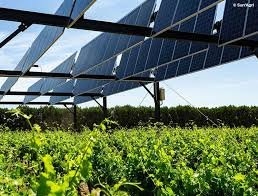
AI for Smart Agrivoltaic Systems addresses an elegant dual-use idea: growing crops and generating solar power on the same land. You learn the fundamentals of agrivoltaics — how panel placement affects the light, temperature and water that crops receive — then how AI optimises the inevitable trade-offs. The course covers modelling and predicting both energy yield and crop performance, and using data to balance and co-optimise them across seasons. Set within the goals of sustainable land use and food-energy security, it shows AI turning a complex system into a manageable one. You finish able to reason about an AI-optimised agrivoltaic design. A verified e-Certificate of competency and e-Marksheet from the Deep Science & Technology Consortium.
🎯 Program Aim
This course applies AI to agrivoltaics — systems that co-locate solar power and agriculture — optimising energy yield, crop growth and their shared use of land and light.
📋 Course Objectives
1. Explain agrivoltaic systems and the light and water trade-off.
2. Model energy yield and crop performance.
3. Use AI to co-optimise energy and agriculture.
4. Balance land, light and water across seasons.
5. Connect design to food-energy sustainability.
👥 Who Should Enroll?
• Renewable-energy and agri-tech professionals
• Agrivoltaics and sustainability researchers
• Data scientists in energy and agriculture
• Students of sustainable systems
🚀 Key Learning Outcomes
• An understanding of AI in agrivoltaics.
• An energy-and-crop optimisation perspective.
• A sustainable land-use approach.
• A verified e-Certificate of competency and e-Marksheet from the Deep Science & Technology Consortium.
💎 What You'll Gain
Live & Recorded Sessions
Lifetime access to class recordingse-Certificate on Completion
Cryptographically verified credentialPost-Programme Support
Direct access to mentors & councilHands-On Experience
Notebooks, real-world code & datasetsCurriculum Outline
AI Fundamentals, Mathematics, and Foundations
Develop a comprehensive understanding of artificial neural networks and their applications in agrivoltaic systems • Analyze the mathematical foundations of machine learning, including linear algebra and calculus, and their relevance to smart agrivoltaic systems • Design and implement simple machine learning models using Python and popular libraries like TensorFlow or PyTorch
Data Engineering, Preprocessing, and Feature Pipelines
Configure and manage large datasets for agrivoltaic systems using data engineering tools like Apache Beam or AWS Glue • Evaluate and implement data preprocessing techniques, including handling missing values and data normalization, for improved model performance • Develop and deploy feature pipelines using tools like Apache Spark or Dask to extract relevant features from agrivoltaic system data
Model Architecture, Algorithm Design, and Methods
Design and implement deep learning models, including convolutional neural networks and recurrent neural networks, for agrivoltaic system applications • Analyze and compare different algorithmic approaches, including supervised, unsupervised, and reinforcement learning, for smart agrivoltaic systems • Develop and evaluate model architectures using techniques like cross-validation and hyperparameter tuning
Training, Hyperparameter Optimization, and Evaluation
Train and optimize machine learning models using hyperparameter tuning techniques like grid search, random search, or Bayesian optimization • Evaluate and compare model performance using metrics like accuracy, precision, recall, and F1-score, and visualize results using tools like Matplotlib or Seaborn • Implement and manage model training workflows using tools like TensorFlow Extended or MLflow
Deployment, MLOps, and Production Workflows
Deploy trained models to production environments using containerization tools like Docker or Kubernetes • Develop and manage MLOps workflows using tools like Apache Airflow or Zapier to automate model deployment and monitoring • Configure and implement model serving systems using tools like TensorFlow Serving or AWS SageMaker
Ethics, Bias Mitigation, and Responsible AI Practices
Analyze and mitigate bias in machine learning models using techniques like data preprocessing, feature engineering, and model regularization • Develop and implement responsible AI practices, including transparency, explainability, and accountability, in agrivoltaic system applications • Evaluate and address ethical concerns in AI development, including fairness, privacy, and security
Industry Integration, Business Applications, and Case Studies
Develop and implement AI-powered solutions for real-world agrivoltaic system applications, including crop yield prediction and energy optimization • Analyze and evaluate case studies of successful AI adoption in agrivoltaic systems, including lessons learned and best practices • Design and propose business models and revenue streams for AI-powered agrivoltaic system applications
Technical Specifications
| Parameter | Requirement |
|---|---|
| Covered Tool / Platform | Python |
| Covered Tool / Platform | TensorFlow |
| Covered Tool / Platform | PyTorch |
| Covered Tool / Platform | Apache Beam |
| Covered Tool / Platform | AWS Glue |
Frequently Asked Questions
Scholar Feedback & Reviews
Based on 0 scholar submissions
Rating Breakdown
No verified reviews published yet. Be the first to share your academic experience.
Leave Scholar Feedback
Your rating will help prospective scholars. Ratings below 3 stars are routed privately to the faculty mentor for immediate response.