Programme Parameters
Graduate / Intermediate
4 Weeks (40 Hrs)
Online (e-LMS)
• A basic understanding of the subject area and fundamental programming or scientific concepts.
• A laptop or desktop with a stable internet connection.
• Willingness to complete assignments and the capstone project.
About This Course
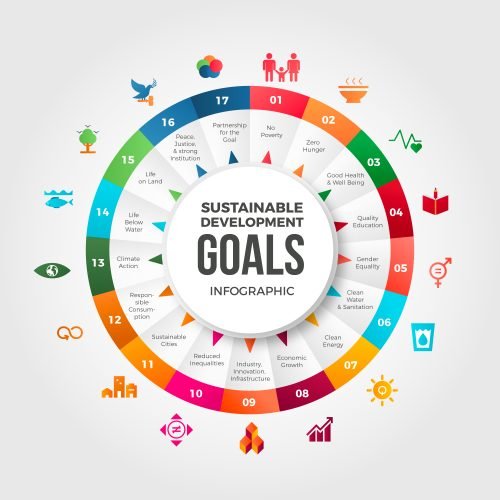
Systems Thinking for Sustainable Development Goals equips you to see the SDGs as an interconnected system rather than a checklist. You learn the core tools of systems thinking — feedback loops, stocks and flows, unintended consequences and leverage points — and apply them to the tangled challenges of sustainable development, where action on one goal ripples across others. The course builds the holistic reasoning that complex sustainability problems demand. You finish able to analyse an SDG challenge through a systems lens. A verified e-Certificate of competency and e-Marksheet from the Deep Science & Technology Consortium.
🎯 Program Aim
This course applies systems thinking to the Sustainable Development Goals — using interconnections, feedback and leverage points to address complex sustainability challenges.
📋 Course Objectives
1. Apply systems-thinking tools and concepts.
2. Map feedback loops and interconnections.
3. Identify leverage points for change.
4. Anticipate unintended consequences.
5. Analyse SDG challenges holistically.
👥 Who Should Enroll?
• Sustainability and development professionals
• Policy and NGO staff
• Researchers in sustainability
• Students of sustainable development
🚀 Key Learning Outcomes
• A systems view of sustainable development.
• A holistic problem-solving toolkit.
• An SDG systems-analysis perspective.
• A verified e-Certificate of competency and e-Marksheet from the Deep Science & Technology Consortium.
💎 What You'll Gain
Live & Recorded Sessions
Lifetime access to class recordingse-Certificate on Completion
Cryptographically verified credentialPost-Programme Support
Direct access to mentors & councilHands-On Experience
Notebooks, real-world code & datasetsCurriculum Outline
AI Fundamentals, Mathematics, and Systems Thinking Foundations
Apply mathematical concepts such as linear algebra and calculus to solve complex problems in AI for sustainable development • Design and implement AI models using Python and relevant libraries to analyze and visualize data for SDGs • Evaluate the performance of AI models using metrics such as accuracy, precision, and recall to inform systems thinking for sustainable development
Data Engineering, Preprocessing, and Feature Pipelines
Develop data pipelines using tools such as Apache Beam and Spark to preprocess and feature-engineer large datasets for SDGs • Configure and optimize data storage solutions such as relational databases and NoSQL databases for efficient data retrieval and analysis • Analyze and visualize data using techniques such as data mining and machine learning to inform systems thinking for sustainable development
Model Architecture, Algorithm Design, and Systems Thinking Methods
Design and implement deep learning models such as convolutional neural networks and recurrent neural networks to solve complex problems in SDGs • Develop and evaluate algorithmic solutions using techniques such as reinforcement learning and transfer learning to inform systems thinking for sustainable development • Integrate systems thinking principles into AI model development to ensure holistic and sustainable solutions for SDGs
Training, Hyperparameter Optimization, and Evaluation
Train and optimize AI models using techniques such as stochastic gradient descent and Bayesian optimization to achieve high performance on SDG-related tasks • Evaluate the performance of AI models using metrics such as mean squared error and mean absolute error to inform hyperparameter tuning and model selection • Develop and implement strategies for hyperparameter optimization and model selection to ensure robust and reliable AI solutions for SDGs
Deployment, MLOps, and Production Workflows
Deploy AI models using cloud-based platforms such as AWS and Azure to ensure scalability and reliability for SDG-related applications • Develop and implement MLOps pipelines using tools such as TensorFlow Extended and MLflow to streamline model development and deployment • Configure and optimize production workflows using techniques such as continuous integration and continuous deployment to ensure efficient and reliable AI solution deployment
Ethics, Bias Mitigation, and Responsible AI Practices
Analyze and mitigate bias in AI models using techniques such as data preprocessing and algorithmic auditing to ensure fairness and transparency in SDG-related applications • Develop and implement strategies for responsible AI development and deployment, including transparency, explainability, and accountability • Evaluate the ethical implications of AI solutions using frameworks such as human-centered design and value-sensitive design to inform systems thinking for sustainable development
Industry Integration, Business Applications, and Case Studies
Develop and implement AI solutions for real-world business applications, including customer service, marketing, and supply chain management, to drive sustainable development • Analyze and evaluate case studies of AI adoption in various industries, including healthcare, finance, and education, to inform systems thinking for SDGs • Design and propose AI-powered business models and solutions to drive sustainable development and achieve SDGs
Technical Specifications
| Parameter | Requirement |
|---|---|
| Covered Tool / Platform | Python |
| Covered Tool / Platform | TensorFlow |
| Covered Tool / Platform | PyTorch |
| Covered Tool / Platform | Scikit-learn |
Frequently Asked Questions
Scholar Feedback & Reviews
Based on 0 scholar submissions
Rating Breakdown
No verified reviews published yet. Be the first to share your academic experience.
Leave Scholar Feedback
Your rating will help prospective scholars. Ratings below 3 stars are routed privately to the faculty mentor for immediate response.