Programme Parameters
Graduate / Intermediate
4 Weeks (40 Hrs)
Online (e-LMS)
• A basic understanding of the subject area and fundamental programming or scientific concepts.
• A laptop or desktop with a stable internet connection.
• Willingness to complete assignments and the capstone project.
About This Course
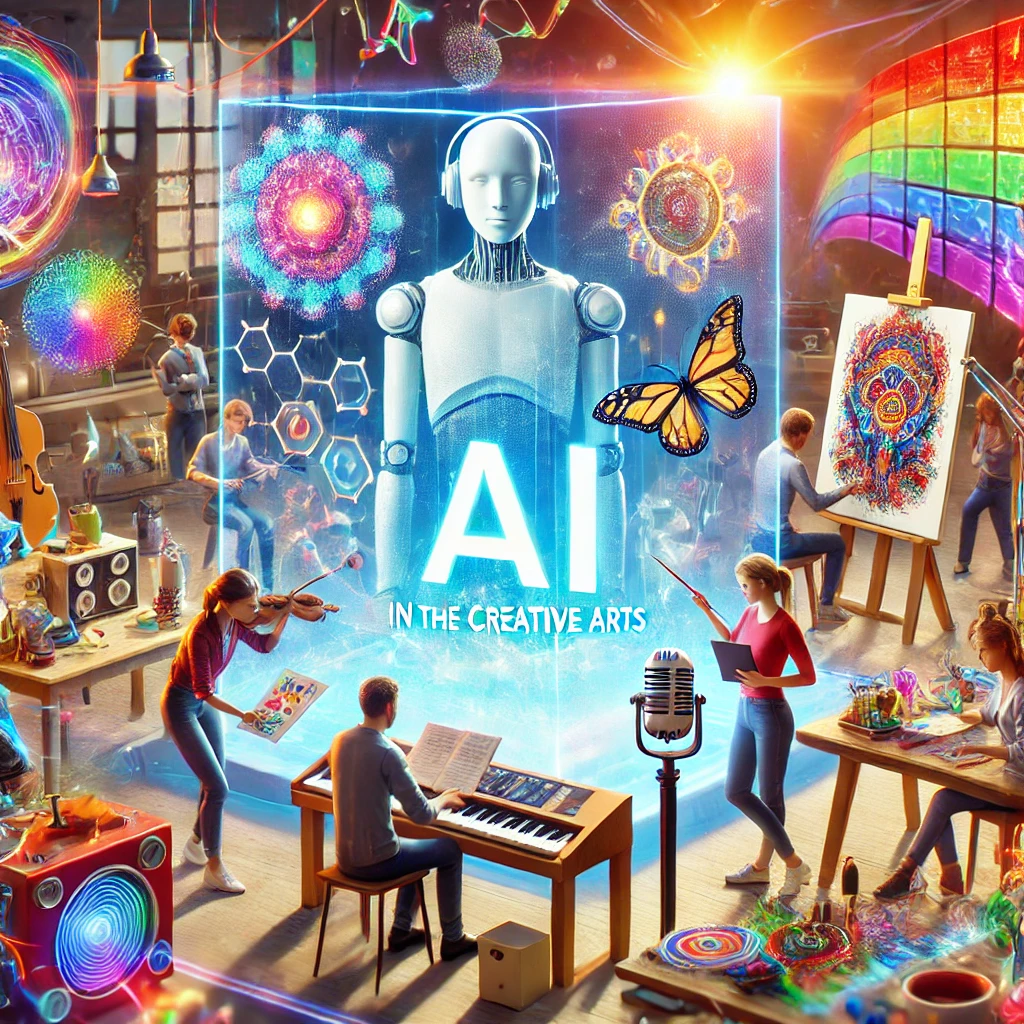
AI in the Creative Arts explores how generative models are changing image, music, writing and design. You work hands-on with the tools driving this shift — diffusion models for images, language models for text, and generative systems for audio — learning not just to prompt them but to steer them toward a creative intent. Beyond technique, the course engages the genuinely open questions the field raises: authorship, originality, copyright and the evolving role of the human artist. You leave able to use generative AI as a creative collaborator with a clear-eyed view of its implications. A verified e-Certificate of competency and e-Marksheet from the Deep Science & Technology Consortium.
🎯 Program Aim
This course explores generative AI in the creative arts — image, music, text and design generation with diffusion and language models, and the questions of authorship they raise.
📋 Course Objectives
1. Generate images with diffusion models and guided prompting.
2. Use language models for creative writing.
3. Explore generative audio and music tools.
4. Steer generative systems toward a creative intent.
5. Engage authorship, copyright and originality questions.
👥 Who Should Enroll?
• Artists, designers and musicians exploring AI
• Content creators and media professionals
• Developers building creative AI tools
• Students at the art-and-technology intersection
🚀 Key Learning Outcomes
• Practical fluency with generative creative tools.
• A portfolio of AI-assisted creative work.
• An informed view of AI’s role in the arts.
• A verified e-Certificate of competency and e-Marksheet from the Deep Science & Technology Consortium.
💎 What You'll Gain
Live & Recorded Sessions
Lifetime access to class recordingse-Certificate on Completion
Cryptographically verified credentialPost-Programme Support
Direct access to mentors & councilHands-On Experience
Notebooks, real-world code & datasetsCurriculum Outline
AI Fundamentals, Mathematics, and Foundations
Develop a comprehensive understanding of AI concepts, including machine learning, deep learning, and neural networks • Analyze the mathematical foundations of AI, including linear algebra, calculus, and probability theory • Design and implement simple AI models using Python and popular libraries such as NumPy and Pandas
Data Engineering, Preprocessing, and Feature Pipelines
Configure and manage large datasets for AI model training, including data cleaning, preprocessing, and feature engineering • Evaluate and select appropriate data preprocessing techniques, including handling missing values and data normalization • Implement data pipelines using tools such as Apache Beam, Spark, or AWS Glue
Model Architecture, Algorithm Design, and Methods
Design and implement convolutional neural networks (CNNs) for image classification and object detection tasks • Develop and train recurrent neural networks (RNNs) for natural language processing and time series forecasting tasks • Analyze and compare the performance of different AI algorithms, including supervised, unsupervised, and reinforcement learning
Training, Hyperparameter Optimization, and Evaluation
Train and optimize AI models using popular frameworks such as TensorFlow, PyTorch, or Keras • Evaluate and compare the performance of different AI models using metrics such as accuracy, precision, and recall • Implement hyperparameter tuning techniques, including grid search, random search, and Bayesian optimization
Deployment, MLOps, and Production Workflows
Deploy AI models in production environments, including cloud, on-premises, and edge deployments • Design and implement MLOps pipelines, including model monitoring, logging, and versioning • Configure and manage AI model serving platforms, including TensorFlow Serving, AWS SageMaker, or Azure Machine Learning
Ethics, Bias Mitigation, and Responsible AI Practices
Analyze and identify potential biases in AI models, including data bias, algorithmic bias, and human bias • Develop and implement strategies for bias mitigation, including data preprocessing, feature engineering, and model regularization • Evaluate and compare the performance of different AI models using fairness metrics, including equality of opportunity and demographic parity
Industry Integration, Business Applications, and Case Studies
Design and implement AI solutions for real-world business problems, including customer segmentation, recommendation systems, and predictive maintenance • Analyze and compare the performance of different AI models using business metrics, including return on investment (ROI) and customer lifetime value (CLV) • Develop and present AI-powered business cases, including market analysis, competitive landscape, and financial projections
Technical Specifications
| Parameter | Requirement |
|---|---|
| Covered Tool / Platform | Python |
| Covered Tool / Platform | TensorFlow |
| Covered Tool / Platform | PyTorch |
| Covered Tool / Platform | Keras |
| Covered Tool / Platform | NumPy |
| Covered Tool / Platform | Pandas |
Frequently Asked Questions
Scholar Feedback & Reviews
Based on 0 scholar submissions
Rating Breakdown
No verified reviews published yet. Be the first to share your academic experience.
Leave Scholar Feedback
Your rating will help prospective scholars. Ratings below 3 stars are routed privately to the faculty mentor for immediate response.